B.S. in Comprehensive Medical Imaging
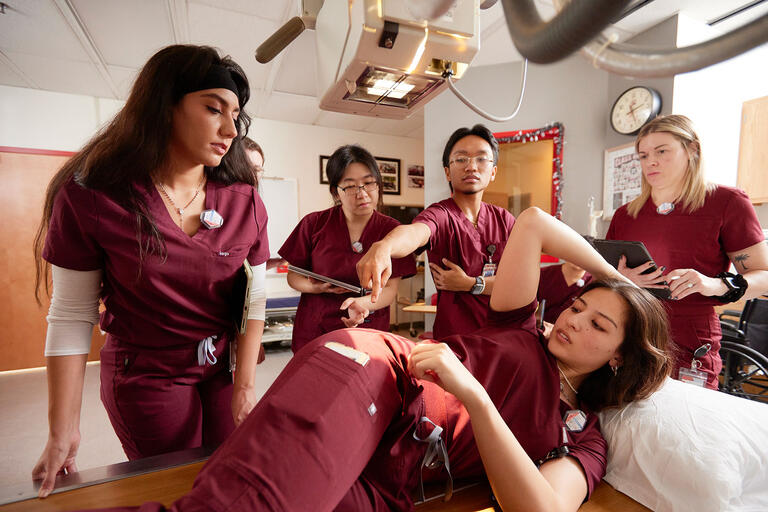
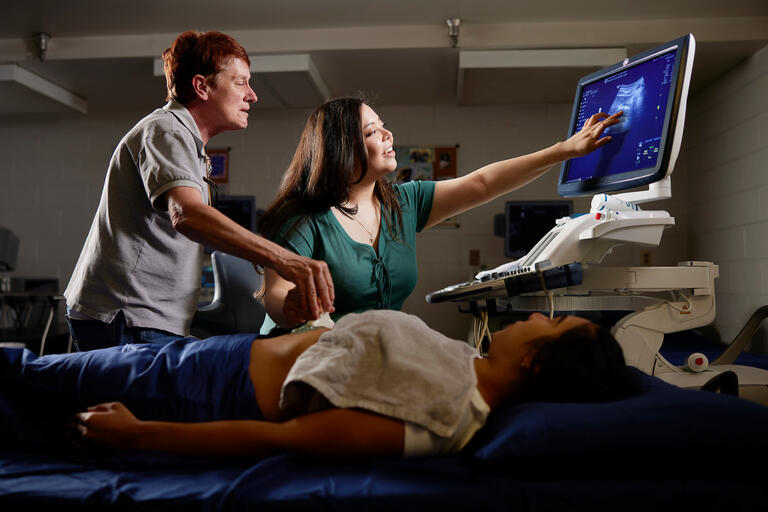
The comprehensive medical imaging program at UNLV is an innovative academic program designed to educate students in a foundation of mathematics and the sciences applicable to the interdisciplinary and applied science of diagnostic imaging. The program currently offers theoretical and clinical course work in the advanced level modalities of Computed Tomography, Magnetic Resonance Imaging and Ultrasound. Graduates of the Program will meet the demand for professional personnel to perform patient imaging procedures on state-of-the-art advanced imaging systems, process and enhance computer images, prepare and administer contrast agents, maintain strict quality control guidelines, and conduct research in the comprehensive medical imaging area.
Certification Examinations:
The curriculum provides a solid understanding of comprehensive medical imaging principles that will assist students wishing to write for the national registry in their chosen imaging modality. Note that eligibility to write the ARRT national registry in MRI requires previous national certification in either radiography or nuclear medicine.Eligibility to write the ARRT national registry in CT requires national certification in radiography. To be considered board eligible in ultrasound, a student must have completed 1680 clinical hours. Professional growth and development in the field is maintained through participation in continuing education course work offered both at local and national professional society meetings and within the Department of Health Physics at UNLV.
Career Opportunities:
The employment outlook in comprehensive medical imaging is excellent. Radiology administrators and physicians in hospitals and outpatient clinics have responded to the concerns of cost containment and competition by seeking prospective employees who can demonstrate competency in a variety of imaging areas. The comprehensive imaging program at UNLV provides an opportunity for students to become competent professionals in multiple diagnostic modalities within the framework of a strong baccalaureate program. Job opportunities for graduates may be found in major medical centers, smaller hospitals, and independent imaging centers. Opportunities are also available for obtaining positions in clinical research and administration.
Download CMI Requirements Handout (PDF)
Admission Requirements
Admission to the University does not guarantee admission to academic programs within the Department of Health Physics.
Applicants to the B.S. in Comprehensive Medical Imaging (CMI) Program must fulfill the following admission requirements:
1. A cumulative high school GPA of at least 3.00/4.00, or
2. A cumulative GPA of 2.75/4.00 or higher for credits taken at UNLV or accepted in transfer by the university.
Applicants not meeting these requirements may be admitted on a probationary status and must complete 30 credits in the Program and/or University required courses at UNLV with a cumulative GPA of 2.50/4.00 or above in order to remain in the Program. Previous coursework will be evaluated for adequacy by an advisor.
Students interested in the CT or MR option must also have successfully completed a nationally accredited radiography program of study prior to admission into the program. Students are also eligible for admission to the MR option if they have successfully completed a nationally accredited nuclear medicine program of study.
Interested students must complete a B.S. in Comprehensive Medical Imaging Program Application Form, or a Change of Major Form and submit it to the Department of Health Physics Office either by mail, fax (895-4819), or email to doris.coomes@unlv.edu
Pre-CMI Majors (PRECMI)
All applicants meeting the above admission requirements will be accepted into the B.S. in Comprehensive Medical Imaging Program initially as a pre-CMI (PRECMI) major. Each PRECMI student is assigned an academic advisor upon admission to the Program. PRECMI students are encouraged to meet with their advisor at least once a semester to determine which classes they should take in order to meet the requirements for full acceptance into the Comprehensive Medical Imaging major (CMI), as well as for general professional advisement. A B.S. in CMI Program Checklist is used as an advising tool during these sessions. Note that PRECMI majors will not be allowed to take Comprehensive Medical Imaging courses with a CMI prefix at this time without the permission of the Program Director.
Comprehensive Medical Imaging Majors (CMI)
Students interested in seeking full acceptance into the Comprehensive Medical Imaging major (CMI) must have a cumulative GPA of 2.75/4.00 or higher in 60 credits taken at UNLV or accepted in transfer by the university. Applicants must submit a CMI Application Form to be considered for admission as a CMI major to the Comprehensive Medical Imaging Program Director by noon on the last Friday in February each year for possible entrance the following Fall semester. Note that acceptance to the CMI major is a competitive process and that successful completion of the CMI admission requirements does not guarantee acceptance as a CMI major.
UNLV Admission Information for International Students
Progression Requirements
Students must:
- Maintain a cumulative GPA of 2.50/4.00 or higher each semester enrolled and have no negative grade points.
- Receive a grade of C or better in all required CMI, HPS, or RAD courses.
- Not register for the same CMI, HPS, or RAD course more than two times (except CMI 490 and CMI 485).
- Students who have successfully completed a nationally accredited radiography or nuclear medicine program prior to their admission to the CMI degree program must pass a national registry in radiography or nuclear medicine prior to graduation.
- Student progression into CMI clinical course work may be limited based upon the availability of clinical sites.
Degree Requirements:
English Composition and Literature |
9 credits |
Mathematics |
5 or 6 credits |
Computer Science |
3 credits |
Constitutions |
4 credits |
Social Sciences |
9 credits |
Fine Arts |
3 credits |
Humanities |
6 credits |
Multicultural |
(see note 1) |
International |
(see note 1) |
Sciences |
24 credits |
CMI Science Core (Ultrasound Option) |
43 credits |
Electives – Ultrasound Option (see note 4) |
18 credits |
CMI Science Core (CT/MRI Option) |
38 credits |
Electives – CT/MRI Option (see note 5) |
23 credits |
Total |
124 credits |
Notes:
- Every student must complete a three-credit multicultural course and a three-credit international course. Courses satisfying other requirements may simultaneously satisfy the multicultural and international requirements except one course cannot satisfy both the multicultural and international requirements
- CMI 485 must be taken for a minimum of two semesters.
- CMI 490 must be taken for a minimum of three semesters and may be repeated for up to 15 credits (subject to availability of clinical sites). Up to 6 credits of CMI 490 (beyond the nine required) may be used as electives.
- Up to 15 credits of RAD courses (or equivalent) can serve as electives (excluding RAD 100, 102 and 117).
- Up to 20 credits of RAD courses (or equivalent) can serve as electives (excluding RAD 100, 102 and 117).
Description of the above courses may be found on-line. (PDF File Format)
Comprehensive Medical Imaging Program Course of Study (pdf)
Comprehensive Medical Imaging Advising Sheet (pdf)
Comprehensive Medical Imaging Ultrasound Option Course of Study (pdf)
Comprehensive Medical Imaging Ultrasound Option Advising Sheet (pdf)