Masters in Health Physics Program
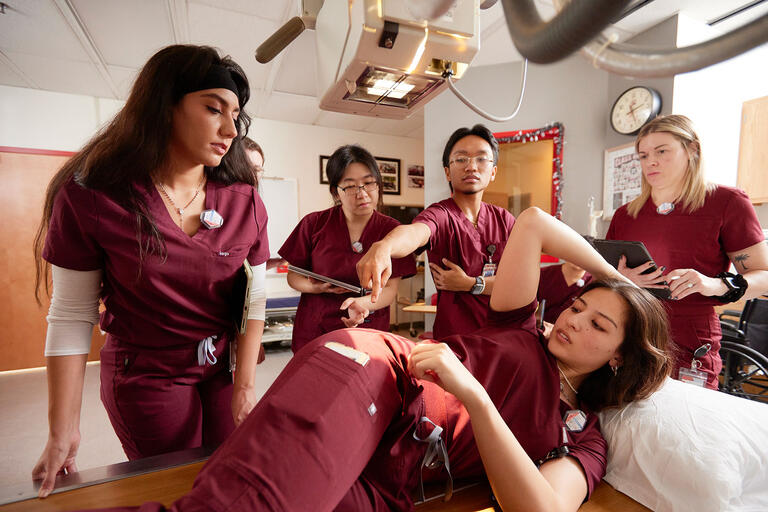
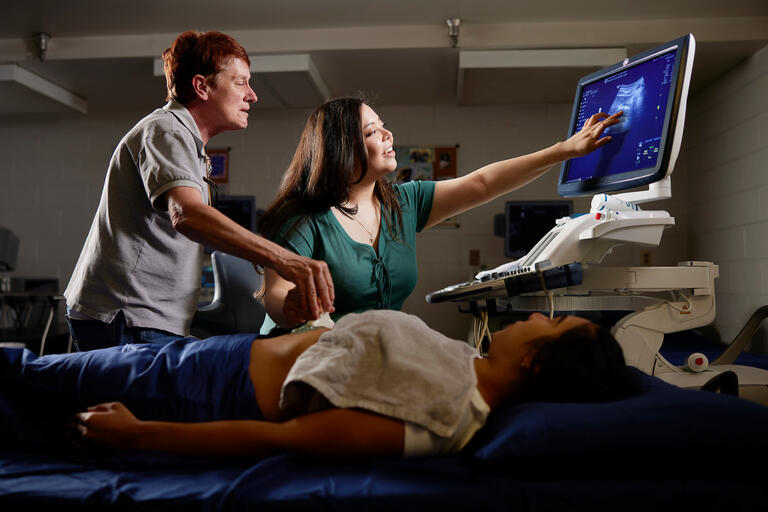
The mission of the Master of Science in Health Physics Program is to provide a high-quality graduate education experience for students in the areas of environmental health physics and medical physics.
The educational experience is accomplished through rigorous classroom instruction aided by computer and multi-media instruction, practical laboratory experiences, student research, and mentoring. The products of this experience are professionals capable of critical thinking and problem solving, devoted to a lifetime of learning, committed to the ethical standards of their profession, and highly sought after by employers.
Admission Requirements
Students seeking admission to the graduate program in health physics must fulfill the following admission requirements:
- Overall GPA
of 3.00 (A=4.00 or equivalent) in undergraduate work. Applicants
with a GPA
below 3.00, but not less than 2.75, may be admitted as a graduate provisional student.
- Successful completion (grade of C or better)
of the following course work:
- Seven-semester credits in biology including an introductory modern biology course and one higher-level course
- Ten-semester credits in chemistry or geology including a general chemistry sequence and one higher-level course
- Eight-semester credits in elementary calculus (mathematics through differential equations is recommended)
- Twelve-semester credits in physics including a general physics sequence
- A course in computer programming (an additional course in numerical methods or scientific computing is recommended)
- Completion of a baccalaureate degree in health physics, one of the basic sciences, or in a closely related scientific or engineering field. Applicants holding a degree in a non-related field may be given special consideration if they have completed all prerequisite coursework.
- A composite score of 1,000 or higher on the verbal and quantitative sections of the Graduate Record Examination (GRE).
- Three letters of recommendation from former instructors or employers that speak to the applicant’s potential as a graduate student. The individual writing the letter may use the form available from the Graduate College, which includes a release form for the student to sign.
- A statement of approximately 300 words indicating the student’s professional goals and reason for seeking graduate education.
- International applications whose native language is not English must show competency in the English language before they can be admitted. A satisfactory score (minimum 550 on the written or 213 on the computerized version) on the “Test of English as a Foreign Language” (TOEFL) or comparable evidence of competency in English must be submitted by students as part of their application.
UNLV Graduate Admission information
UNLV Graduate Admission Information for International Students
Progression Requirements
To progress in the Program students must:
- Maintain a cumulative
GPA of 3.00/4.00 or above each semester enrolled.
- Receive a
grade of B (3.00) or above in all core health physics courses.
If less than a B is earned, the course may be repeated.
The student must be in good standing to repeat a course, and
any core course may be repeated only once.
- A student may register
for a course only twice. A student who registered for the same
course twice and has received a grade less
than B is ineligible for readmission unless unanimously approved
by Health Physics graduate faculty.
- Complete a minimum of six
semester hours in each calendar year.
- Continuously register for three credits of HPS 796 or HPS 797 each semester while working on the thesis or professional paper until completion.
Advisement
The Health Physics Graduate Program Director will serve as academic advisor to all entering students for program planning. At the time the student selects his/her examination committee, the committee chairperson becomes the student’s official advisor.
Degree Requirements
Requirements for the Master of Science in Health Physics include completion of 36 semester hours in required and elective graduate courses. These requirements will be established in consultation with the student's advisor in accordance with the Department of Health Physics and Graduate College policy and shall include:
1. Health Physics Core (21 credits):
HPS 602, 603, 620, 680, 701, 718, 720, and 791(three times)
2. Electives (9 credits):
Graduate-level health physics or other approved graduate courses. It is recommended that electives include a statistics course and either the Environmental Health Physics or Medical Physics areas listed below:
a. Environmental Health Physics: HPS 670, 750
b. Medical Physics: HPS 740, 742
3. Completion of a thesis or professional paper project (6 credits): HPS 796 or 797.
Description of the above courses may be found on-line.
Graduation Requirements
Students in the M.S. in Health Physics Program must adhere to the following requirements for graduation:
1. Residency Credits: A minimum of 20 credits exclusive of thesis or special topic project must be earned at UNLV. A minimum of 15 credits must be accumulated within the Program. Attendance at the University of Nevada, Reno does not interrupt, but does not contribute to, residency credits, because this institution is within the University and Community College System of Nevada.
2. Credit by Challenge Examination. Graduate courses in the M.S. in Health Physics Program may not be challenged for credit.
3. Six-Year Completion Rule. All degree requirements must be completed within six calendar years from the date of matriculation. No credit may be used in an advanced degree program for coursework completed more than six calendar years immediately preceding the term in which all degree requirements are completed.
4. Allotment of Credits. Students have a choice of catalog under which they wish to graduate a) the year of official matriculation, or b) the year of graduation. Students are encouraged to meet requirements of the current catalog.
5. A final oral examination will be held following completion of the thesis or professional paper resulting from a special topics project. The final examination must be held at least three weeks prior to the last day of instruction in the term in which the student plans to complete the degree requirements.
The Program Educational Objectives for the M.S. in Health Physics Program are as follows:
Program Objective #1: Graduates will demonstrate competency in applying the theoretical and problem solving aspects of health physics and related disciplines.
Program Objective #2: Graduates will demonstrate competency in the practical applications of health physics.
Program Objective #3: Graduates will effectively communicate technical information in both oral and written form.
Program Objective #4: Graduates will be competent in research methods and be able to critically review research with the intent of applying findings to their practice.
Program Objective #5: Graduates will be prepared to pursue a lifetime of self-directed learning and professional development.
Program Objective #6: Graduates will conduct themselves in a professional and ethical manner.